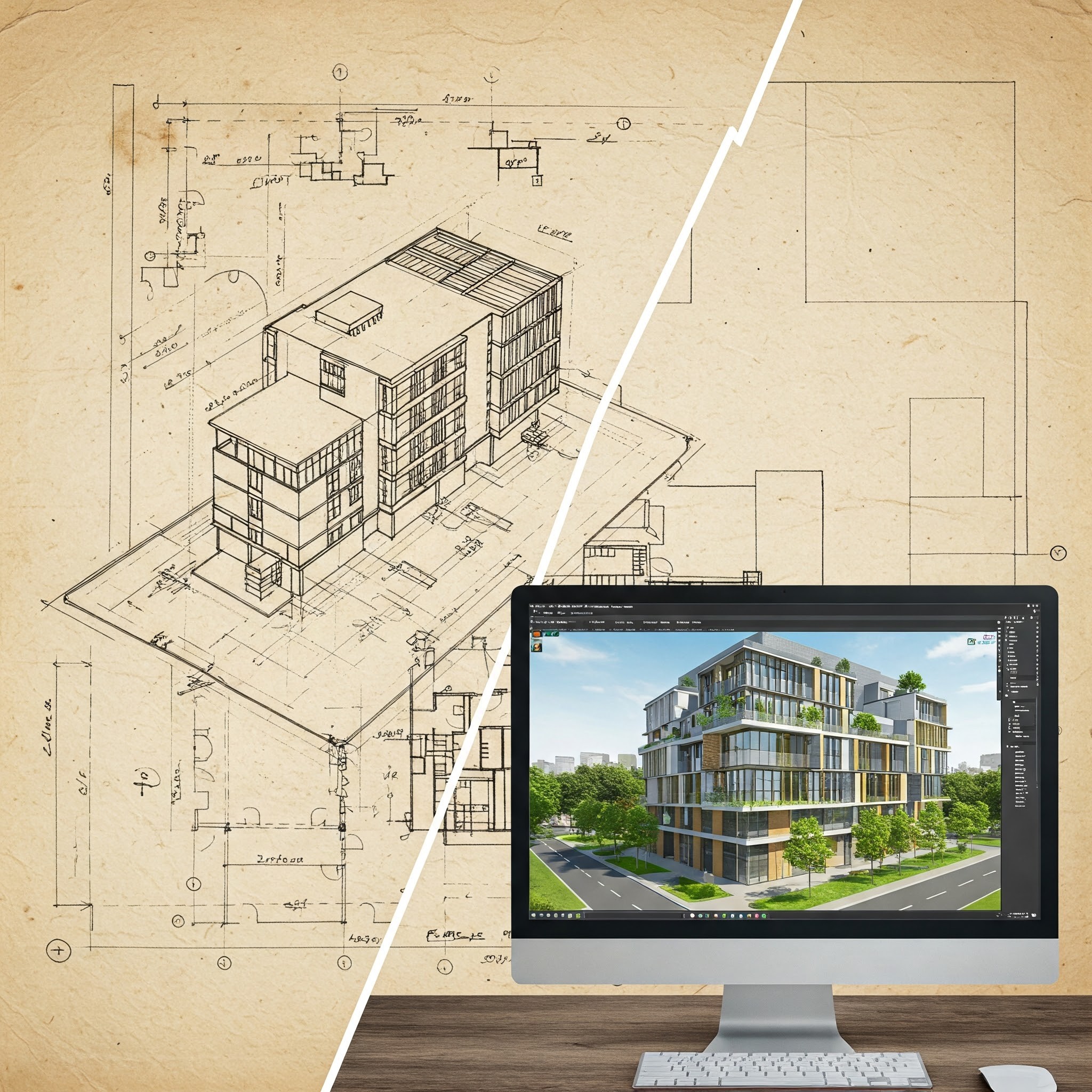
For centuries, architectural drawing sets have been the silent language of the built world. From the first sketches on parchment to today’s intricate digital models, they’ve bridged the gap between vision and reality. These documents, the primary communication tool for architects, engineers, and builders, are undergoing a profound evolution driven by digital technologies. Imagine trying to construct a complex structure without a clear blueprint – an impossibility! This week, we’ll delve into the foundational role of architectural drawing sets and how Building Information Modeling (BIM) is revolutionizing their creation and application, setting the stage for a digital future.
What Are Architectural Drawing Sets? (And How BIM Changes Them)
Traditionally, architectural drawing sets are a comprehensive collection of 2D drawings that detail every aspect of a building project. These include floor plans, elevations, sections, and schedules, each providing specific information for construction.
BIM, however, transforms this paradigm. It’s a digital representation of the physical and functional characteristics of a facility. Unlike traditional drawings, BIM integrates data and geometry into a single, intelligent 3D model. From this model, traditional drawings are generated, but they now carry a wealth of embedded information. This means a more coordinated and information-rich set of drawings, where every element is linked and consistent.
The Function of Drawing Sets (In a BIM-Enabled World)
Construction Guidance
Traditional drawings provide instructions for construction.
BIM provides more accurate and detailed information, reducing errors and rework.
BIM enables fabrication and prefabrication by providing precise data for manufacturing.
Communication
Traditional drawings translate the architect’s design in 2D.
BIM enhances communication through 3D visualization, allowing all stakeholders to understand the design in a more intuitive way.
BIM facilitates clash detection and coordination between disciplines before construction, preventing costly errors.
Legal Documentiation
Traditional drawing sets are legal documents.
BIM models are increasingly recognized as legal documents and data repositories, offering a comprehensive record of the project.
The Importance of Clarity and Intent (With Digital Precision)
Clear and accurate drawings are essential for successful construction. Unclear or ambiguous drawings can lead to costly mistakes and delays. BIM minimizes these risks by providing precise and consistent information.
BIM allows for the architect’s design intent to be more clearly conveyed through 3D visualization and data integration. It also facilitates better building code checking by automating compliance analysis. Furthermore, robust data management and model health are crucial in BIM, ensuring the reliability and accuracy of the information.
Transmittal of Drawings and Models
Traditionally, drawings were transmitted as physical copies. BIM allows for the digital transmittal of models and their embedded data. This enables faster and more efficient collaboration.
Cloud-based collaboration platforms are now essential for sharing BIM models and drawings. These platforms allow multiple users to access and work on the same model simultaneously, regardless of their location.
Architectural drawing sets have evolved from simple 2D representations to information-rich 3D models, thanks to BIM. This shift enhances accuracy, communication, and efficiency, transforming how we design and construct buildings.
Setting the Stage for a Digital Future
This week, we’ve laid the foundation for understanding the importance of drawing sets and the transformative power of BIM. In the coming weeks, we’ll delve deeper into specific aspects of BIM, including its role in design, analysis, and project management.
We encourage you to share your questions and experiences with the transition to BIM in the comments below. Let’s discuss how we can leverage these technologies to build a more efficient and sustainable future.